I was looking into background literature today for a class I'm assisting with this coming Spring. The class deals with the mosquito gut microbiome and its relevance to malaria transmission, an issue relevant to hundreds of millions of people worldwide. A paper in the Journal of Medical Entomology caught my eye, mostly because it's another case of "I've never heard of that genus or species before!" The species in question is the Gram-negative Elizabethkingia meningoseptica and these folks found it in the midgut of Anopheles stephensi, a mosquito known to be a vector for the malaria parasite. E. meningoseptica not only appears to have antimicrobial properties but has a toxic effect on malaria parasites as well (in vitro, at least).
This bacterial species isn't newly discovered but it's been known by other names. It's been in the genus Flavobacterium and in Chryseobacterium previously. It's been associated with soft tissue infections, even among immunocompetent individuals (but hey, all kinds of species can become opportunistic under the right conditions).
Here's that mosquito paper:
Ngwa CJ, Glöckner V, Abdelmohsen UR, Scheuermayer M, Fischer R, Hentschel U, Pradel G. 2013. 16S rRNA Gene-Based Identification of Elizabethkingia meningoseptica (Flavobacteriales: Flavobacteriaceae) as a Dominant Midgut Bacterium of the Asian Malaria Vector Anopheles stephensi (Dipteria: Culicidae) With Antimicrobial Activities. J. Med. Entomol. 50:404–414.
Monday, December 15, 2014

Friday, December 12, 2014
Here's another example of the interplay between microbes and phage. The authors call it BREX (for BacteRiophage EXclusion, emphasis mine) and unlike other phage resistance systems, BREX doesn't seem to cleave viral DNA. It doesn't appear to be as consistently conserved as CRISPR, either - its components may primarily be exchanged horizontally (see Fig 6 in the paper) among many bacterial and archaeal genomes.
Goldfarb, T. et al. BREX is a novel phage resistance system widespread in microbial genomes. EMBO J. e201489455 (2014). doi:10.15252/embj.201489455
Goldfarb, T. et al. BREX is a novel phage resistance system widespread in microbial genomes. EMBO J. e201489455 (2014). doi:10.15252/embj.201489455
Sunday, December 07, 2014
Parallel emotions
Every so often, I'll crack open Emotional Intelligence 2.0 for some novel viewpoints. The book is set up as a series of lists of strategies for improving social awareness, relationship stability, and the like. In a different context, they'd be called life hacks. The strategies vary in quality and detail but are good starting points. I tend to find them useful in principle but not in their proposed execution.
Here's the example I came across today: a self-awareness strategy described as "Spot Your Emotions in Books, Movies, and Music." The general idea is that you can improve knowledge of your own emotional state and reactions by observing how you respond to art and literature. It sounds straightforward but one comment struck me as questionable.
The same philosophy is used to teach reading to children. It could be useful to encourage older students (say, college freshmen) about their own emotional responses to art and literature rather than just their analysis of it. I still think that what they'll tend to find memorable isn't primarily about their own parallel emotions. There's so much else involved that I'd hesitate to use the word probably when discussing anyone's reaction to art.
Here's the example I came across today: a self-awareness strategy described as "Spot Your Emotions in Books, Movies, and Music." The general idea is that you can improve knowledge of your own emotional state and reactions by observing how you respond to art and literature. It sounds straightforward but one comment struck me as questionable.
...when a character from a movie or book sticks in your head, it's probably because important aspects of his or her thoughts or feelings parallel your own.Is that really true? Do I find characters memorable primarily because I see myself in them or because they are different from me? Is parallel the right word, or would intersect serve a better purpose? How we react to the world around us - including the art and cultural products we're exposed to - can certainly serve as a viewpoint to our own emotions. I'd just like to think that I find characters or thoughts interesting for reasons far beyond their similarity to what I'm already experiencing.
The same philosophy is used to teach reading to children. It could be useful to encourage older students (say, college freshmen) about their own emotional responses to art and literature rather than just their analysis of it. I still think that what they'll tend to find memorable isn't primarily about their own parallel emotions. There's so much else involved that I'd hesitate to use the word probably when discussing anyone's reaction to art.
Friday, December 05, 2014
Another bit of R
R makes it easy to chop up and reassemble data frames, whether it's with the subset() function or with dplyr's filter() function. It isn't always obvious how to do it for a whole data frame. That's where apply() is useful.
This will filter a data frame such that all columns have at least one value less than zero in any row, for example:
newdata.df <- data.df[ ,apply(data.df, MARGIN = 2, function(x) any(x < 1))]
any() can be exhanged for all() to restrict the selection to columns in which all values are less than one.
The same code works for rows: just move the apply(...) in front of the comma, then change MARGIN to 1 instead of 2.
This will filter a data frame such that all columns have at least one value less than zero in any row, for example:
newdata.df <- data.df[ ,apply(data.df, MARGIN = 2, function(x) any(x < 1))]
any() can be exhanged for all() to restrict the selection to columns in which all values are less than one.
The same code works for rows: just move the apply(...) in front of the comma, then change MARGIN to 1 instead of 2.
Wednesday, December 03, 2014
This is an example of how an interesting idea can be a technological success while failing at numerous aspects of execution.
There's often a lot in common between science and art. Practitioners of both fields constantly have to prove their relevance to jaded audiences. Scientists and artists may be equally passionate about the importance of each detail of their work, but too much detail (especially without context!) can derail any relevance. It's a tricky balance. Too much passion and detail is indistinguishable from Time Cube. Lose the detail while keeping the passion and you end up with a TED talk.* Lose the passion but keep the detail and your hard work becomes drab and unpalatable.
I don't mind a bit of pretension but a little goes a long way.
*TED talks have their place. They're essentially sermons, though some are more evangelical than others.
There's often a lot in common between science and art. Practitioners of both fields constantly have to prove their relevance to jaded audiences. Scientists and artists may be equally passionate about the importance of each detail of their work, but too much detail (especially without context!) can derail any relevance. It's a tricky balance. Too much passion and detail is indistinguishable from Time Cube. Lose the detail while keeping the passion and you end up with a TED talk.* Lose the passion but keep the detail and your hard work becomes drab and unpalatable.
I don't mind a bit of pretension but a little goes a long way.
*TED talks have their place. They're essentially sermons, though some are more evangelical than others.
Monday, December 01, 2014
Sunday, November 30, 2014
I read this short piece by Wasim Salman today. It's another reminder that cyberpunk is dead because we're already living a post-cyberpunk existence. The piece doesn't make that influence subtle: it's framed using Neuromancer. At this point, direct Gibson references are futurist scripture.
Monday, November 24, 2014
A short note about a large building
There's a warehouse in Lacey, Washington State. It's 2 million square feet inside (more than 185,000 square meters, but that number isn't as startling). It's one of the largest buildings in the world. Target uses it to store imported merchandise prior to distribution.
Here it is on a Google Map. Zoom out a few times and you'll still be able to see it more clearly than anything else around.
Here it is on a Google Map. Zoom out a few times and you'll still be able to see it more clearly than anything else around.
Thursday, November 20, 2014
It's not your (segmentation) fault
Hi there. It's time for a quick market segmentation break. I'm talking about how marketers categorize their audience into different groups, i.e., young people vs. old people or single people vs. families. This segmentation can get very high-resolution once behavioral data enters the picture. You've likely seen those surveys about soda brands and political affiliations.*
For a quick look at your own local market segmentation, plug your ZIP code into this Nielsen site.
My neighborhood is rich in Up-And-Comers (younger people with college educations, no kids, and hybrid Nissan Altimas). If you've seen a lot of targeted advertising in recent years, it's not entirely your fault. Blame your neighbors.
There are some clear comparisons to be made here between marketing demographics and microbial ecology. The taxonomy tends to be more clear-cut when it comes to microbial species, but both microbes and humans occupy specific niches for specific reasons. I'd also guess that, much as microbial cultures usually involve more than one species,** human societies rarely match any specific market segment. If they did, the segmentation model wouldn't be terribly useful.
I tend to be inherently distrustful of marketing but its methods could offer some novel insights into microbial communities.
*Also relevant from that survey: the question "Is Olive Garden Authentic?"
**Plus phage!
For a quick look at your own local market segmentation, plug your ZIP code into this Nielsen site.
My neighborhood is rich in Up-And-Comers (younger people with college educations, no kids, and hybrid Nissan Altimas). If you've seen a lot of targeted advertising in recent years, it's not entirely your fault. Blame your neighbors.
There are some clear comparisons to be made here between marketing demographics and microbial ecology. The taxonomy tends to be more clear-cut when it comes to microbial species, but both microbes and humans occupy specific niches for specific reasons. I'd also guess that, much as microbial cultures usually involve more than one species,** human societies rarely match any specific market segment. If they did, the segmentation model wouldn't be terribly useful.
I tend to be inherently distrustful of marketing but its methods could offer some novel insights into microbial communities.
*Also relevant from that survey: the question "Is Olive Garden Authentic?"
**Plus phage!
Wednesday, November 19, 2014
Of paper mountains and mysterious broths
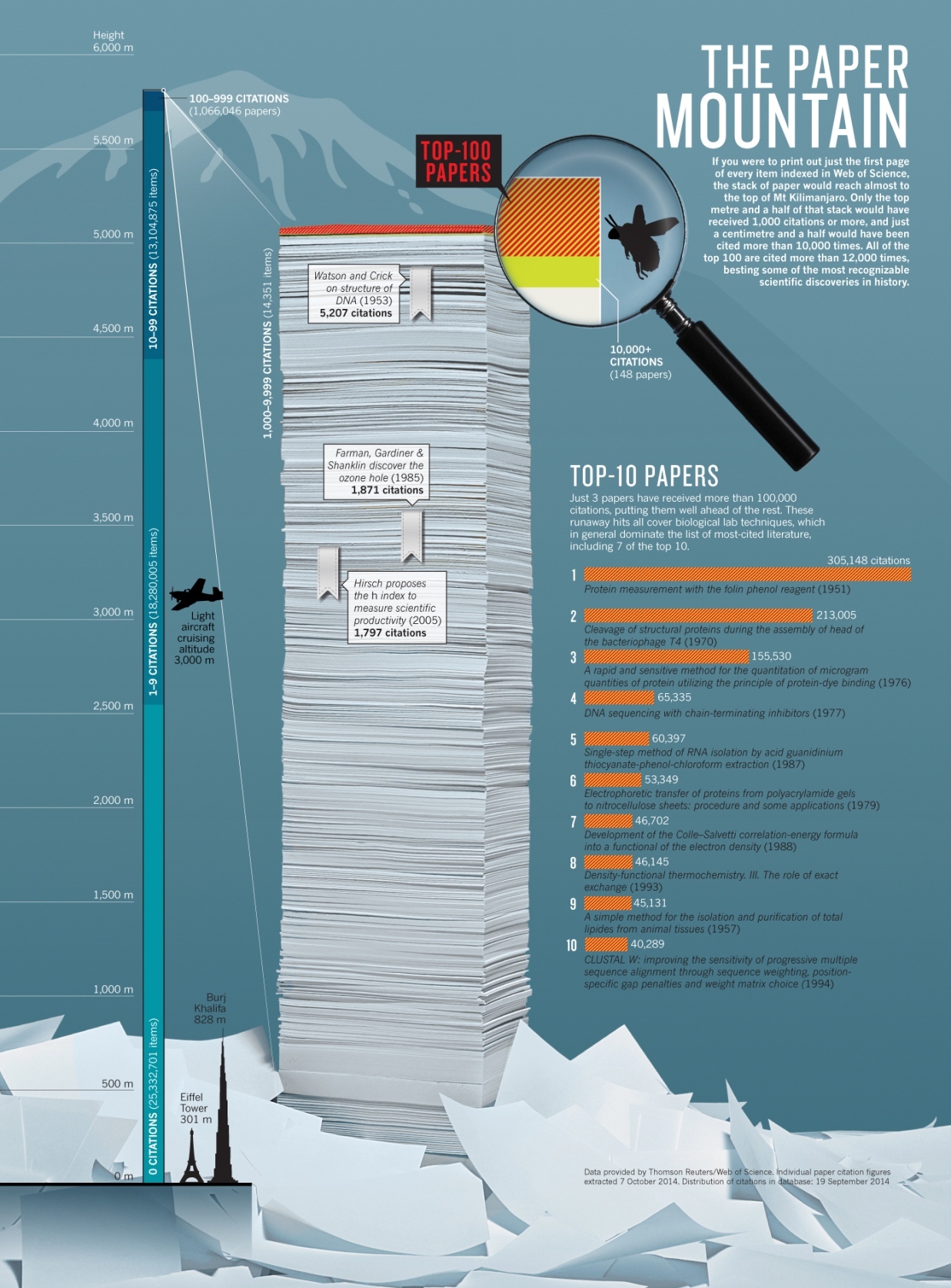
Nature has had a few articles lately about the most highly-cited research papers in existence. This infographic is part of the most recent analysis. The whole context can get a bit silly so I'm glad they approached it from more of a popular-science direction than a genuinely metatextual one. I'm also not a fan of most infographics so it's nice to see a clean, compact figure like this one or the interactive figure in the main article.*
There are few surprises here: the most frequently-cited papers are those offering novel scientific methods or easy implementations of those methods. The Altschul BLAST papers are a great example. They describe sequence comparison methods which are so easy to use and powerful that everyone from undergraduates to senior researchers still find them useful on a daily basis. Of course, methods eventually become common knowledge and people either stop citing them, replace them with newer methods, or just forget who created the methods in the first place. Laemmli buffer, described in a 1970 paper by its namesake,** is still used in proteomics studies, but so is LB medium, a recipe originally described as "lyosgeny broth" but often called "Luria-Bertani" medium after its creator, Giuseppe Bertani, and the microbiologist Salvador Luria.***
*Apologizes if you can't access content behind the paywall! I'm not sure if this article is broadly accessible but it really ought to be.
** Yes, that's right, the seminal paper by Dr. Buffer.
***The 1951 paper is here. This 2004 review offers a nice historical perspective.
There are few surprises here: the most frequently-cited papers are those offering novel scientific methods or easy implementations of those methods. The Altschul BLAST papers are a great example. They describe sequence comparison methods which are so easy to use and powerful that everyone from undergraduates to senior researchers still find them useful on a daily basis. Of course, methods eventually become common knowledge and people either stop citing them, replace them with newer methods, or just forget who created the methods in the first place. Laemmli buffer, described in a 1970 paper by its namesake,** is still used in proteomics studies, but so is LB medium, a recipe originally described as "lyosgeny broth" but often called "Luria-Bertani" medium after its creator, Giuseppe Bertani, and the microbiologist Salvador Luria.***
*Apologizes if you can't access content behind the paywall! I'm not sure if this article is broadly accessible but it really ought to be.
** Yes, that's right, the seminal paper by Dr. Buffer.
***The 1951 paper is here. This 2004 review offers a nice historical perspective.
Monday, November 17, 2014
I read this Newsweek article about negative results this morning. It's not bad as far as mainstream science and medicine reporting goes, though that's admittedly a low bar to clear.
It's obvious that negative results need to be published. The urgency is especially clear when those negative results could have direct implications for health.
Even so, I was struck by the metaphor used in a JAMA article the Newsweek piece quoted:
It's obvious that negative results need to be published. The urgency is especially clear when those negative results could have direct implications for health.
Even so, I was struck by the metaphor used in a JAMA article the Newsweek piece quoted:
“In baseball, it is easy to find out just how well Cal Ripken has hit against various pitchers in the past, at home or away games, in recent weeks or during his career,” Dickersin and Rennie wrote. “Yet in medicine, there is no comprehensive source for finding out similar, accurate statistics for medical interventions. How can baseball be better organized and keep better records than medical science?”The comparison really triggers some knee-jerk pedandry for me. Yes, the authors are being a bit tounge-in-cheek. It still isn't a fair comparison at all. Baseball has clearly defined rules which haven't changed much over the last century. We can compare batting averages from 1914 with those from 2014 and understand what the values mean in both contexts. There really isn't a way to do that with medical treatments other than whether patients lived or died (even that is a moving target, and a recursive one at that since medical science impacts life expectancy). Truly useful long-term results may take decades to obtain. Most baseball games don't take that long.
Thursday, November 13, 2014
I just found this software called Beaker today - it's essentially a way to mash together several different data analysis and presentation languages, allowing output from one to seamlessly become input for the next. To be fair, this isn't too difficult to do manually as long as the data sets are properly organized, but it's frequently a pain to convert something like R output to a presentable format without a few extra steps. Beaker appears to handle that. It'll even export to LaTeX as far as I can tell, so I can put off learning that for another year or so!
I haven't had a chance to try it out yet, but if Beaker is really as helpful as it seems then it could really save me some time. It would be nice to automatically export sets of R code and output to pretty HTML, at least.
I haven't had a chance to try it out yet, but if Beaker is really as helpful as it seems then it could really save me some time. It would be nice to automatically export sets of R code and output to pretty HTML, at least.
Sunday, November 09, 2014
I should have gone to Fire Investigator school: The Work Importance Profiler
I took another work-related quiz this past week: the Work Importance Profiler. You can take it yourself here. This kind of survey was once called the Minnesota Importance Questionnaire, but despite what the name may imply, it's not about how folks feel about Minnesota.* The survey determines your values in a work context. The theory is this: you may sacrifice your skills and interest to work at an easy, uninteresting job, but you will rarely sacrifice your values. Those values include who you become as part of your job, what you get, who you get to know, and how others regard you.
Here are my results:

OK, to be fair, weighting values like this may be misleading. Working Conditions may rank below Achievement in this list but I still wouldn't work at a job with a genuinely terrible work environment (let's picture a BSL-4 virology lab without proper ventilation, for example). I do tend to value accomplishment above all else. I would never want a job where I don't feel like I'm accomplishing anything.
I'm not sure if it's part of the standard survey, but the values can be converted into career categories. Here are my top 10 matches:

Ah, so I should be an actor! These results don't appear to correlate with those from interest surveys like the Strong so I have to take them with a grain of salt.
*I imagine it would look like this.
Here are my results:
OK, to be fair, weighting values like this may be misleading. Working Conditions may rank below Achievement in this list but I still wouldn't work at a job with a genuinely terrible work environment (let's picture a BSL-4 virology lab without proper ventilation, for example). I do tend to value accomplishment above all else. I would never want a job where I don't feel like I'm accomplishing anything.
I'm not sure if it's part of the standard survey, but the values can be converted into career categories. Here are my top 10 matches:
Ah, so I should be an actor! These results don't appear to correlate with those from interest surveys like the Strong so I have to take them with a grain of salt.
*I imagine it would look like this.
Wednesday, October 29, 2014
The smallest of the small
The topic of a "minimal bacteriophage" came up in conservation with my lab's PI and postdoc yesterday. I got philosophical about it: what is a phage other than a genome, some structural proteins, and the means to enter bacterial cells? If we began removing items from a phage genome piece-by-piece, at what point would the genome cease to code for a phage? The questions really seem to concern how much genetic information is really necessary to self-propagate.
There are some incredibly small phages out there, of course. Phage MS2 is a single-stranded RNA phage which infects E. coli and similar species. Its genome is just under 3600 nucleotides and contains just four genes. It was the first full genome to be sequenced - that small size made it a great candidate. It also seems to be used as a model for viruses in water quality studies.
So is MS2 a minimal bacteriophage? At the very least, its single capsid protein self-assembles into capsids and can even be used to encapsulate a protein of choice. If a phage needs to have a capsid then MS2 certainly passes the test. The other MS2 genes also provide basic functions: attachment, replication, and lysis. I'm guessing that the only way to get smaller would be to optimize or completely lose one of those functions (except for attachment, as it still needs to stick to something on its host surface), but would it still be a virus?
Wednesday, October 22, 2014
Tuesday, October 21, 2014
Oh say say say.
R provides a seemingly endless toolbox of data visualization options. As a quick example, I was trying to find a way to create a treemap yesterday and a Flowingdata post provided the ideal R solution. It requires the portfolio package. Here's a test with some randomized data:
> testdata = data.frame(replicate(4,sample(0:1000,150,rep=FALSE)))
> map.market(id=testdata$X1, area=testdata$X2, group=testdata$X4, color=testdata$X3, main="Random Map")
The result looks like this:
True, this example defeats one aspect of the purpose of a treemap. There's usually a hierarchy directed by qualitative variables. There is, in fact, room for two different quantitative variables and one category for each item in the data. We can certainly add a category to the data as it is:
> testdata$category <- ifelse(testdata$X4 > 800,"Large", "Small")
Now, every item with an X4 value greater than 800 will be in one category and everything smaller will be in the other. The output:
As expected, the smaller category ("Large") gets squished into one size of the figure and its contents get resized to fit. I miss the individual data labels though they got a bit dense.
The remaining issue is one of colors. The map.markey function allows for different scales but doesn't appear to provide many customization options. This blog post describes an alternate implementation which is RColorBrewer-friendly. Once installing and loading RColorBrewer (it's essential code, but it never seems to be installed when I need it), the newer treemap method is handled like this:
> treemap(testdata$X1, testdata$X2, testdata$category, testdata$X3, main="Random Map with Categories", pal="Reds", textcol="black")
A treemap like this is likely a bit overkill for most applications, especially if there are too many categories or data items to be informative. A figure like this treemap of Vietnam's industrial exports provides an example: the smaller items are all unlabeled, so why include them? As always, results will vary and depend upon both data and conclusions.
> testdata = data.frame(replicate(4,sample(0:1000,150,rep=FALSE)))
> map.market(id=testdata$X1, area=testdata$X2, group=testdata$X4, color=testdata$X3, main="Random Map")
The result looks like this:
 |
| Ignore the color key - there are no negative values here. |
> testdata$category <- ifelse(testdata$X4 > 800,"Large", "Small")
Now, every item with an X4 value greater than 800 will be in one category and everything smaller will be in the other. The output:
 |
| Neatly-organized boxes. |
The remaining issue is one of colors. The map.markey function allows for different scales but doesn't appear to provide many customization options. This blog post describes an alternate implementation which is RColorBrewer-friendly. Once installing and loading RColorBrewer (it's essential code, but it never seems to be installed when I need it), the newer treemap method is handled like this:
> treemap(testdata$X1, testdata$X2, testdata$category, testdata$X3, main="Random Map with Categories", pal="Reds", textcol="black")
 |
| From Sunset Snowbank to Waxy Red Delicious. |
Thursday, October 16, 2014
What is the worst job in life?
(Like the personal development class I took this past Spring, I am taking another course from which I will be mirroring writing assignments here. This course is about career options so the writing pieces will have a relevant focus. They will remain introspective.)
The worst job I can imagine is a
dull one.
To be fair, when I talk about a
dull job, I'm not talking excluding unpleasant jobs. It's possible that many of
the jobs out there are painful, dangerous, morally questionable, or even just
repulsive in a sensory way. We hear about Mike Rowe-caliber dirty jobs all the
time. They run the gamut from cleaning out septic tanks to cleaning the decks
of fishing boats to castrating sheep. These unquestionably difficult jobs
frequently couple manual labor with personal danger. They're often smelly or
require interacting with substances most reasonable people would choose to
avoid.
That being said, I imagine that
these kinds of jobs have been romanticized just as difficult jobs throughout
history have been. Few people can genuinely say they would want to clean out
septic tanks but it remains a genuinely unique occupation. Someone has to have
the job - and they may not even enjoy it - but its offensive tendencies lend it
notability. We could look at high-seas piracy the same way. For centuries,
piracy has meant living in cramped, disease-ridden places along with murderous
co-workers, all at risk of grievous personal harm. It's not an ideal job for
most people but it's great for billion-dollar movie franchises.
I don't find dirty jobs attractive.
Rather, I'm willing to believe that there are worse options, if only because
there is clear evidence that they exist.
What's worse than cleaning sewage?
Let's imagine a job with the following responsibilities: arrive at workplace,
sit at desk, place headphones on ears, and listen to the sounds of human
suffering for eight hours. The reason for the suffering and the reason for the
listening are both unclear. Requests to management for context are met with
friendly, illegible Post-it notes left by unseen managers. You may take a break
(in fact, it's mandatory to do so every few hours) but it will hurt your
chances of promotion. It's unclear how often promotions occur yet every
employee at this company fights for them. The sounds coming over the headphones
are muffled but seem to mix urgent requests for help with personal insults. The
insults are surprisingly specific and include personal details you've never
made public. The job is the same every day and never requires more or less
effort than that required to stay awake.
I'm essentially describing a
hellish variation on working in a call center, with a few admittedly hyperbolic
additions. The last detail I've included is truly the most discouraging part of
this fictional job. Having to repeat the same types of actions on a daily basis
is bad enough, but doing so without any chance to improve a skill or address a
challenge is essentially prison. An individual with this job may work for years
and gain in nothing but age.
The remaining details in the job
description have more to do with relationships. There are always relationships
between individuals at any organization. It's a function of living in human
society. Companies and organizations are founded by humans, staffed by humans,
and managed by humans. Any effort which renders the experience dehumanizing is
coercive and psychologically harmful. Having to perform unpleasant work (in
this case, listening to suffering and insults) fits the bill and is
dehumanizing because it's not clear why it's necessary or what it's all a part
of. In this example, I've included instances where the company culture favors
misinformation and confusion. I'd like to think that this type of culture,
whether accidental or by design, may contribute the most to feelings of
dehumanization. It's easy to feel less than human when you're not treated with
respect and when you don't know how to earn respect.
I've never worked in a job as bad
as the one I've described. I've come close and I know people who have come
closer. Monotony and dehumanization will repel me from a job faster than any
other offense but I've been very lucky to have avoided them when I can.
Monday, October 13, 2014
Two audiovisual Internet Things which have caught my eye and ear lately:
See Hear Party
See Hear Party
Provide some keywords for visuals and music. The site returns a stew of animated gifs at a frequency roughly corresponding to the music's rhythm. It's a neat project and plays well with the modern derivations of the glitch aesthetic (I still see the term seapunk from time to time though that's likely archaic now, too).
The intended result seems to be something like this, though there are other ways to play the game.
Youtube contains a wealth of isolated tracks (i.e., just the vocals or the drums) from classic songs. What would they sound like if you picked a few at random and mashed them up? That's how new classics get made, right?
Saturday, October 11, 2014
It's Amsterdam Again
The vacation photos continue! There are no more after this, at least as far as this trip goes.
 |
| It's blurry, but I'm sure you get the idea. |
 |
| Follow the flames to escape this backyard without falling into the pool. |
 |
| Let us hide in the Heimatverein. |
 |
| They're proud of their vintage machinery. |
Colored spotlights and water don't mix well. We spent some time hiding from the storm before escaping back to the car. I have to assume that Metelen is now a small lake.
The next morning, we hopped on an early train back to the Netherlands.
 |
| The train tracks in Ochtrup. Not shown: trains. |
 |
| Ah, there they are. Hello, trains. |
 |
| Finally, the hotel. I think three stars is code for "our hallways are fashionably dark but our front desk service is sufficiently friendly". |
 |
| It was time to return to Canal Town. It was much more humid this time. |
 |
| This car is a bit like Amsterdam itself: exposed to more moisture than it probably should be but it remains a charming and colorful patchwork. (That sentence is best read in the voice of Rick Steves.) |
 |
| It's the Royal Palace of Amsterdam. The royal folks don't live there but they visit on occasion. |
 |
| The building is opulent by design. It's what you get to build when you're everyone's favorite merchant society. |
 |
| This flooring stays shiny because it only gets used for state functions. |
 |
| Many of the rooms are still in use by state visitors but were traditionally offices and lodging for government VIPs. This is the Insurance Chamber. It's where the guy in charge of insurance lived. |
 | ||||||||||||||
The Palace hallways are rather dark, both in lighting and in atmosphere. Many of its doorways are decorated with scenes of death and execution.
Having had our fill of 17th century royal excess, we proceeded to the Kattenkabinet. It's a museum of cat art. That is, it doesn't appear to contain any art by cats but it features paintings, sculptures, and advertisements featuring cats. The collection is all nestled into a set of apartments in a very catlike way: unassuming, offering limited context, but undeniably unique.
|



Monday, October 06, 2014
Lists of other peoples' words
I mentioned the book list meme a few posts back, so here's mine. I posted it to Facebook already but it offers more posterity here, plus a chance for context.
This is a Scholastic young adult novel. It sticks with me because it's about the impact of major life choices but it's also notable in a "how did this get published" kind of way. Its storyline is decidedly PG-13 and much more explicit than one might expect from an admittedly surreal coming-of-age story. I think I found it in a library sale during my earliest teen years. The last YA novel I read was the final Harry Potter text so perhaps more modern youth fiction trends towards the surreal as well.
This one is essentially a collection of cyberpunk musings. I read a fair amount of Asimov's Science Fiction as a youth so I was used to the novella format; it works well for cyberpunk. A short story can introduce just enough new ideas to dismantle them all in short order. The whole cyberpunk aesthetic and ethos was so good at deconstruction that the genre rapidly dismantled itself. Wildlife is a great example of the poignancy of such a phenomenon as I see echoes of its ideas in every other headline. A gaggle of apathetically-wealthy teens hold parties themed around destroying priceless museum pieces. Children almost literally become their own parents, if they ever grow up at all. Others grow out instead of growing up.
I don't like to deal in superlatives so I won't call this "the best play ever written". If anything, it's an exercise in balancing restraint and exuberance. I can't remember if I read Equus in high school or college but it was in a setting where most readings are rich in meaning but low in significance. This one startled me. It was significant to me, at least, as a recent adolescent. I couldn't understand the factors necessary to transform a horse into a god (even now, I haven't been on a horse in decades). It truly seems like madness.
4. Cat's Cradle by Kurt Vonnegut
4. Cat's Cradle by Kurt Vonnegut
A classic. It sticks with me as a feeling rather than a discrete set of details.
5. The Life and Opinions of the Tomcat Murr by E. T. A. Hoffmann
5. The Life and Opinions of the Tomcat Murr by E. T. A. Hoffmann
OK, I'll confess. I haven't read more than thirty pages of this one yet. It still manages to stick with me by virtue of sheer, inexplicable weirdness. It's ostensibly a cat's biography
6. The Three Stigmata of Palmer Eldritch by Philip K. Dick
6. The Three Stigmata of Palmer Eldritch by Philip K. Dick
Potentially just as critical to the genre of end-times spiritualism in science fiction as Cat's Cradle, Three Stigmata is one of Dick's more obviously paranoid works of fiction, though that may depend upon your opinion of VALIS. It sticks with me for many of the same reasons as Cat's Cradle does. The entire idea of drug-mediated collective hallucination is, in itself, philosophically challenging.
7. The Bridge Trilogy by William Gibson
7. The Bridge Trilogy by William Gibson
I could also include his Sprawl and Blue Ant trilogies here, though the latter novels lack the breathless futurism of classics like Neuromancer or All Tomorrow's Parties. Gibson defined concepts like cyberspace and that prescience remains present in my mind. It pops up frequently: one of Idoru's core plots involves a convenience store chain installing 3D printers (minor spoiler - a rouge AI takes control of them). Self-aware computers aside, 7-11 could roll out such a service in the next few years and it wouldn't be unexpected. Beyond specific bits of futurism, Gibson was responsible for the whole cyberpunk aesthetic. It's about as dead now as a genre can be but it reappears everywhere from glitch music to failed TV series.
8. 3500 Good Jokes for Speakers by Gerald F. Lieberman
8. 3500 Good Jokes for Speakers by Gerald F. Lieberman
It's an ancient joke book! That is, it's a book of jokes published in the 70's but more appropriate to the 50's or 60's. When I read it in the early 2000's, it was an alien, nearly indecipherable thing full of obscure cultural references lost to the ages. It's also chock-full of racism, sexism, homophobia, and just about any other -phobia you can imagine. Because of all that, it's a great example of the plasticity of humor over time. It's an authentic time capsule.
9. The Incredible Machine by Robert M. Poole (1994 ed.)
9. The Incredible Machine by Robert M. Poole (1994 ed.)
I read this one for the pictures and the pictures are what stick with me, along with an appreciation for biological complexity.
10. CLOSURE by _why
10. CLOSURE by _why
Here's a modern story: a young programmer anonymously contributes code for years. He's knowledgable about the language and frequently implements ways to make it more useful, not only to experienced programmers but to beginners. He produces instruction manuals unlike any other, soaked with surreal cartoons and stories. His personal details escape into the Internet and he leaves every online community he's been part of. The only certain detail is that he needs anonymity.
He may have been suffering from burnout. That's what CLOSURE seems to be about, at least. It's not entirely clear where everything in the collection came from or even who made it. The title was assigned after its initial release. Much like any complex code, it's a dense stew with many cooks.
Burnout isn't exclusive to coding. It can happen in any field, especially when it's not clear what your contributions mean to society. Do they have to mean anything? If so, how long should they remain relevant? Who decides what stays relevant? I wrestle with these questions on a near-daily basis but they haven't won yet.There's a transition here with regards to why books stick around in my mind. The first three books in this list involve fairly nontraditional coming-of-age stories. Life offers multitudinous possibilities and these options appear inconceivably extensive during youth. The possibilities only narrow as we grow older and begin to comprehend where our limitations lie. That being said, we also grow slightly more able to predict future events. We begin to see long-term patterns, even in chaotic situations. Items four through seven on this list fit that latter category: they're all either science fiction or magical realism and they concern massive disasters. In the case of Hoffmann's Tomcat Murr, the disaster is literary. The other stories concern societal collapse and its metaphysical ramifications.
The metaphysical aspect is one which I was surprised to find in this list. Equus, Cat's Cradle, and Palmer Eldritch specifically include folk religions and emergent spiritualism. I'm not entirely sure why this concept is so interesting to me. It appears in some of my other interests; I have been collecting religious literature for several years simply because it's varied and interesting. The idea of the "emerging church" is an interesting one in itself. I'm an outsider to that movement, though, so I'm still trying to understand why I find it so alluring.
Subscribe to:
Posts
(
Atom
)